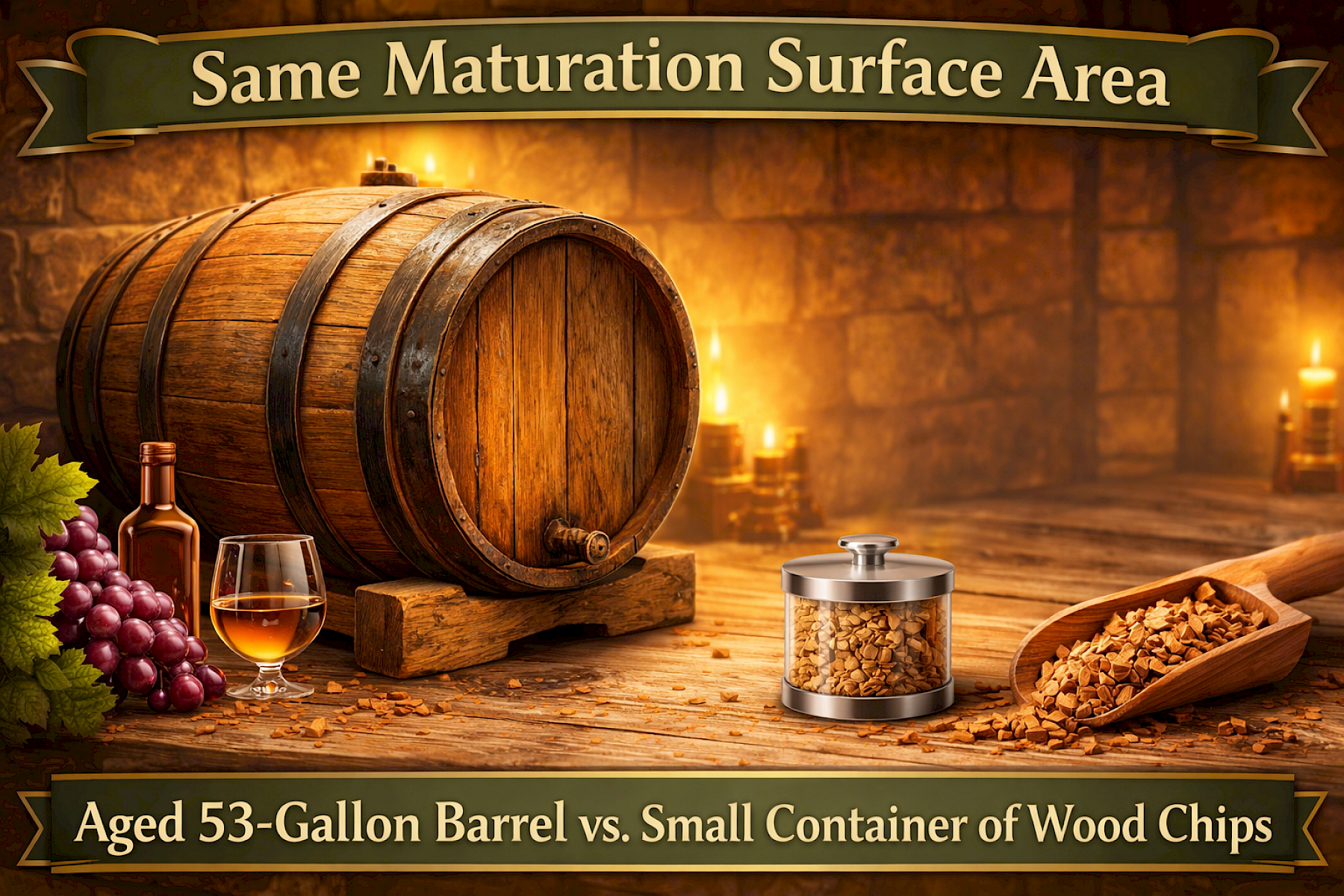
At Springhouse Reserve, we use wood not as a dominant flavor, but as a subtle and powerful tool to refine structure, balance, and mouthfeel. When wood chips—typically toasted American White Oak—are introduced during fermentation and/or finishing, they contribute a range of natural compounds that enhance the wine/spirits in ways both obvious and quietly profound. Also, using wood chips instead of barrels saves you money.
Also, it reduces impact on our nation's diminishing forests. A good quality American White Oak barrel uses about 110 pounds (1,760 ounces) of premium heartwood oak. The barrel will be used perhaps five times in its life. The American White Oak wood chips we use come from forest byproducts-- small branches, flawed boards, etc., and we use only 12 ounces of them (0.7% of the wood in a barrel) to process 53 gallons of wine/spirits and we use those 12 ounces twice (the only requirement is that they be used for finishing the same wine/spirit). We care about America's forests, public or private, and minimize our footprint on them.
The Foundations of Flavor and Aroma
Wood contains complex structural components that, when gently broken down, release compounds that shape aroma and taste:
-
Vanillin – contributes soft vanilla notes
-
Syringaldehyde – adds sweet, warm spice
-
Coniferaldehyde and Sinapaldehyde – bring subtle woody depth
These arise from lignin in the wood, especially when it has been lightly toasted.
Subtle Sweetness and Fresh Oak Character
Oak also contributes compounds known as lactones, which can add:
-
Coconut-like notes
-
Fresh wood character
-
A perception of softness and sweetness
These are more pronounced in some types of oak, but when used carefully, they enhance without announcing themselves.
Structure, Stability, and Balance
One of the most important contributions of wood is structural:
-
Ellagitannins add grip and backbone
-
Help stabilize color
-
Act as natural antioxidants
When introduced during fermentation, these compounds integrate with grape tannins and pigments, helping create a more stable and harmonious wine, during finishing they provide the "barrel notes" needed in whiskey.
Warmth, Spice, and Toast
From the toasting of wood come compounds that suggest depth and age:
-
Guaiacol – smoky, toasted character
-
Eugenol – clove-like spice
-
4-methylguaiacol – warm, complex aromatics
Used with restraint, these contribute to the sense of maturity without overt smokiness.
Caramel and Soft Sweet Notes
Wood also yields compounds from hemicellulose:
-
Furfural – hints of almond and baked bread
-
5-methylfurfural – gentle caramel tones
These are subtle, but they contribute to the impression of richness and completeness.
Mouthfeel and Texture
Beyond flavor, wood contributes to how wine and spirits feel:
-
Polysaccharides released from the wood soften the palate
-
Enhance roundness and viscosity
-
Create a smoother, more integrated finish
This is often the difference between a drink that is simply good and one that feels finished.
Why We Add Wood During Wine Fermentation
Introducing wood during fermentation allows these elements to integrate at the earliest stages:
-
Yeast activity helps transform and soften wood-derived compounds
-
Flavor integration is more seamless
-
Color and structure are improved naturally
Rather than layering oak flavor on top of a finished wine, the wine and wood evolve together from the beginning.
What Wood Does Not Do
Traditional barrel aging also introduces slow oxygen exposure and long-term aging effects. We take a different path.
At Springhouse Reserve, we begin with impeccably crafted wines and spirits using traditional methods and exceptional ingredients. Then, rather than waiting years for a barrel to slowly shape the final character, we apply our own finishing approach—guided, controlled, and intentional.
The result is not a shortcut, but a refinement.
Saving You Money
When all the aspects of traditional barrel aging are considered, a small operation making good quality winesand spirits has an aging cost of $4.00 to $8.00 (depending on barrel quality and labor costs) per bottle. Since they must make a profit on every bottle the price the consumer pays for barrel aging in the the range of $6.00 to $18.00 per bottle.
Our finishing process has a cost of approximately $1.25 per bottle. This saves you quite a bit of money.
Our Philosophy
We do not use wood to make a statement.
We use it to make the wine and spirits better.
When done properly, the contribution of wood should not be something you notice directly. Instead, it should be something you experience:
-
Greater balance
-
Enhanced smoothness
-
A deeper, more complete finish
If you find yourself enjoying the drink without thinking about why—that is exactly the point.
At Springhouse Reserve, wood is not the destination.
It is one of the many tools we use along the way to create something truly extraordinary.